A New Paradigm for Explainable Fault Diagnosis:
Thermodynamic Simulation-assisted Random Forest (TSRF)
Thermodynamic Simulation-assisted Random Forest: Towards explainable fault diagnosis of combustion chamber components of marine diesel engines, Measurement, 2025.
Introduction
In the field of diesel engine combustion chamber fault diagnosis, engineers have long struggled with three critical challenges:
- Data Scarcity:The rarity of real-world fault samples limits the training effectiveness of deep learning models.
- Implementation Gap:Pure physical models are often too computationally intensive for real-time engineering applications.
- The "Black Box" Dilemma:Traditional machine learning models lack transparency, making it difficult to trace the underlying physical mechanisms of a detected fault.
To address these issues, a recent study published in Measurement proposes an innovative and practical framework: leveraging physical simulation to augment machine learning rather than relying solely on data fitting. This approach significantly enhances both the explainability and reliability of fault diagnosis.
The authors introduce the Thermodynamic Simulation-assisted Random Forest (TSRF)—a framework that bridges thermodynamic mechanisms with explainable machine learning. In small-sample environments, this method achieves high diagnostic accuracy while maintaining consistency with physical laws, offering substantial value for marine engineering.
The TSRF Framework
The TSRF framework integrates a 1D thermodynamic model, a Random Forest (RF) classifier, and a SHAP (SHapley Additive exPlanations) interpreter to create a closed-loop diagnostic system.
- Data Generation & Preprocessing:Synthetic datasets covering both normal and faulty conditions are generated via 1D thermodynamic simulation.
- Model Training & Validation:A Random Forest model is trained on the preprocessed data, with performance evaluated through cross-validation.
- Explainability Analysis:The SHAP method is applied to the trained model to identify key thermodynamic parameters and quantify their contribution to the diagnostic results.
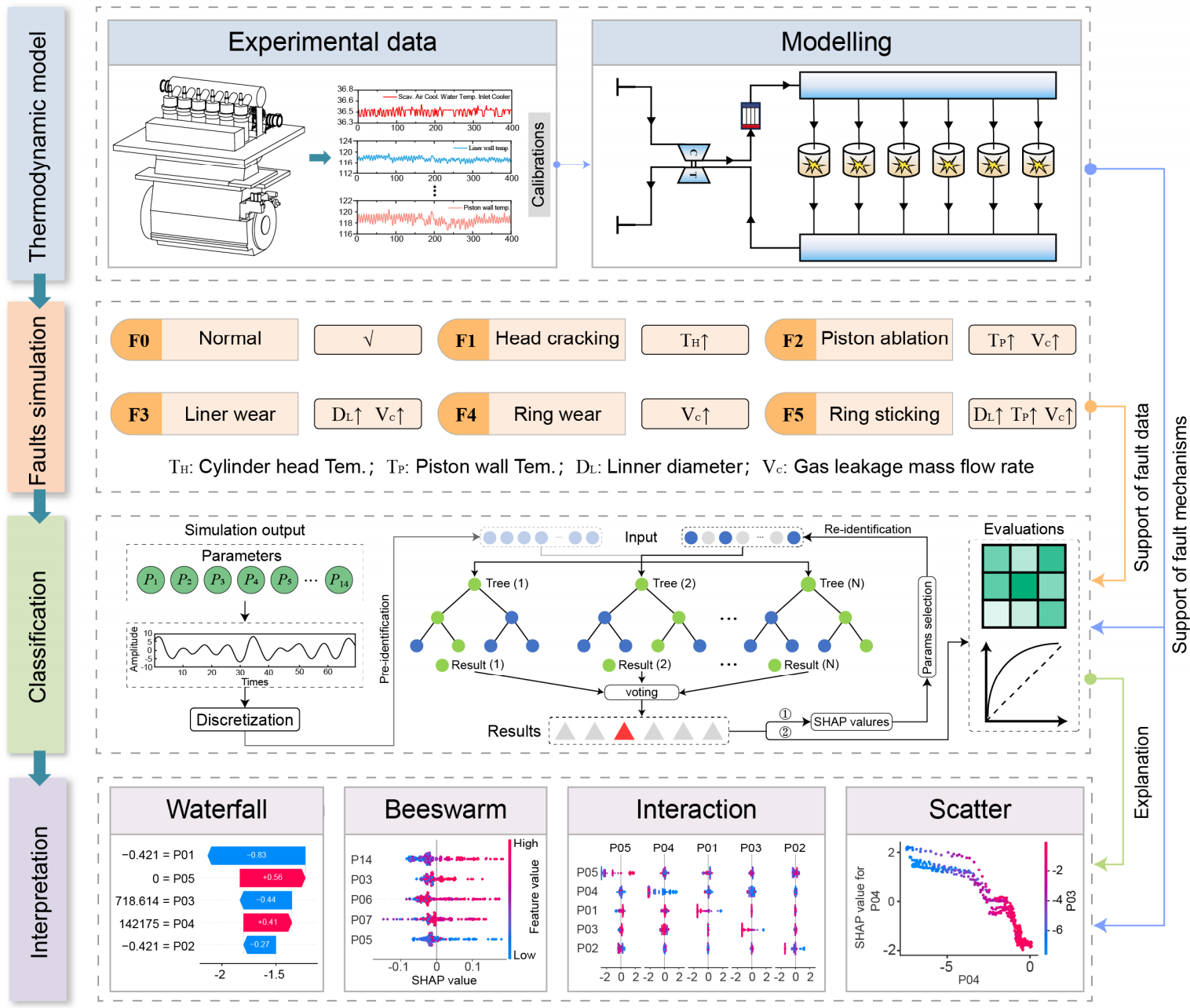
The Thermodynamic Simulation-assisted Random Forest (TSRF) Framework
1D Thermodynamic Model Construction & Calibration
The foundation of the study is a 1D thermodynamic model designed to simulate the thermal behavior of the combustion chamber. The authors performed meticulous calibration against experimental data to ensure the model accurately reflects thermodynamic characteristics under real operating conditions. 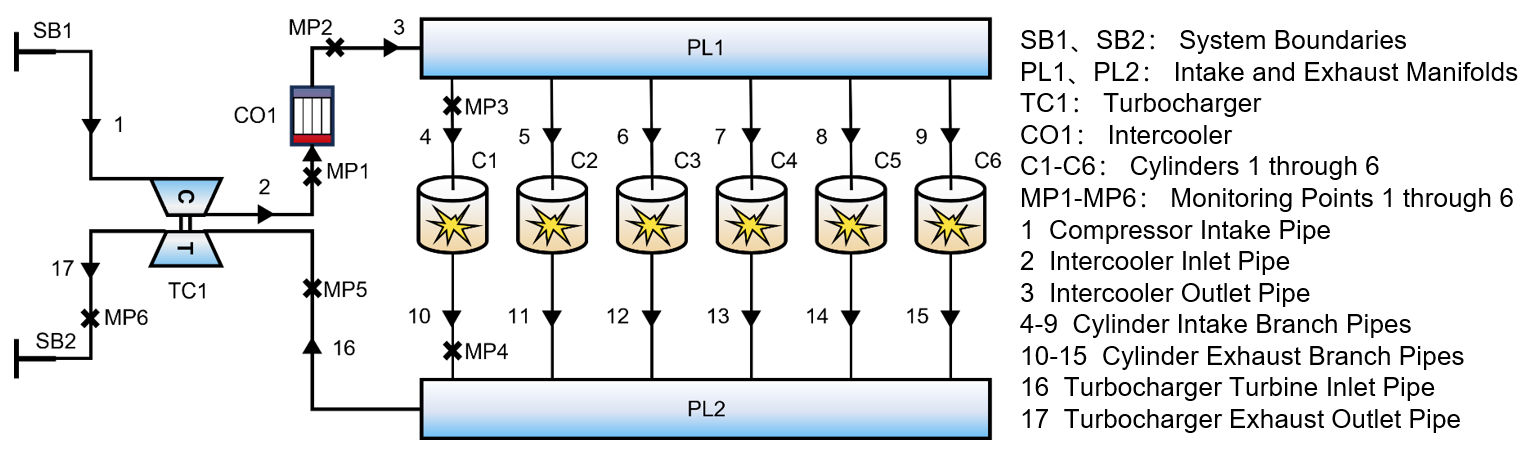
Schematic of the 1D Thermodynamic Model
Furthermore, the model is calibrated using field data acquired through a Data Collection Module (DCM). This ensures that the simulation output remains consistent with the key thermodynamic parameters observed in actual engine operations. 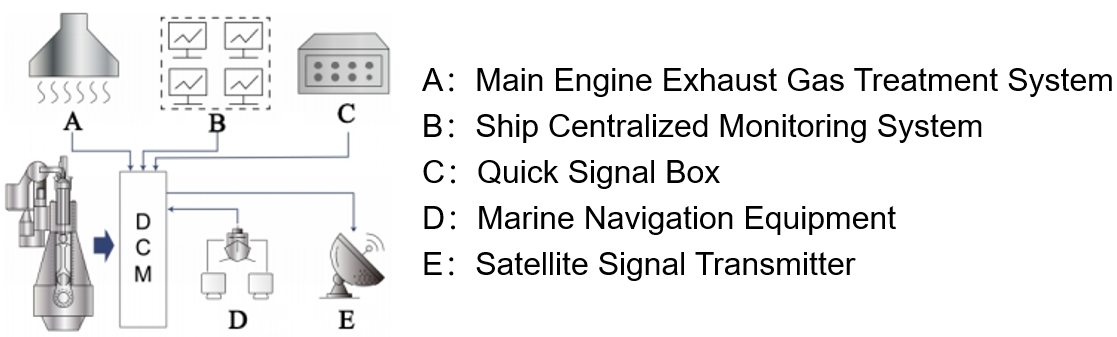
Data Collection Module (DCM)
Physical Modeling & Simulation of Typical Faults
Once calibrated, the authors introduced targeted perturbations to key parameters to simulate five typical combustion chamber faults, ensuring each fault is backed by a clear physical mechanism.
| Fault ID | Fault Type | Physical Mechanism | Key Parameter Adjustments |
|---|---|---|---|
| F1 | Cylinder Head Crack | Thermo-mechanical loading leads to cracking; structural/cooling degradation. | Increase Head Temp (TH) to 346 °C |
| F2 | Piston Erosion | Material degradation causes thermal erosion and increased blow-by. | Increase Piston Temp (TP) + Minor Blow-by (0.01 kg/s) |
| F3 | Cylinder Liner Wear | Abrasive particles cause geometric deformation and seal failure. | Increase Bore Diameter + Heavy Blow-by (0.03 kg/s) |
| F4 | Piston Ring Wear | Wear-induced seal degradation creates a blow-by feedback loop. | Adjust Blow-by Mass Flow Rate (0.02 kg/s) |
| F5 | Piston Ring Sticking | Carbon deposits, poor lubrication, and sludge buildup. | Adjust Bore Diameter + Increase Liner Temp + Blow-by |
This mechanism-driven modeling produces a high-quality, comprehensive dataset that serves as the "ground truth" for machine learning.
Feature Selection via RF and SHAP
With the dataset established, the Random Forest (RF) algorithm is employed as the primary classifier. To solve the "black box" problem, the authors introduce SHAP analysis to provide deep insights into the model's decision-making process.
The feature selection follows a two-stage strategy:
1.RF Preliminary Identification:
- The RF learns the mapping between thermodynamic parameters and fault types.
- Marginal contributions of each parameter are calculated based on prediction scores.
2.Tree SHAP Quantitative Analysis:
- SHAP values are calculated for each parameter.
- Features are filtered based on their SHAP weights, prioritizing those with the highest diagnostic impact and clearest physical significance.
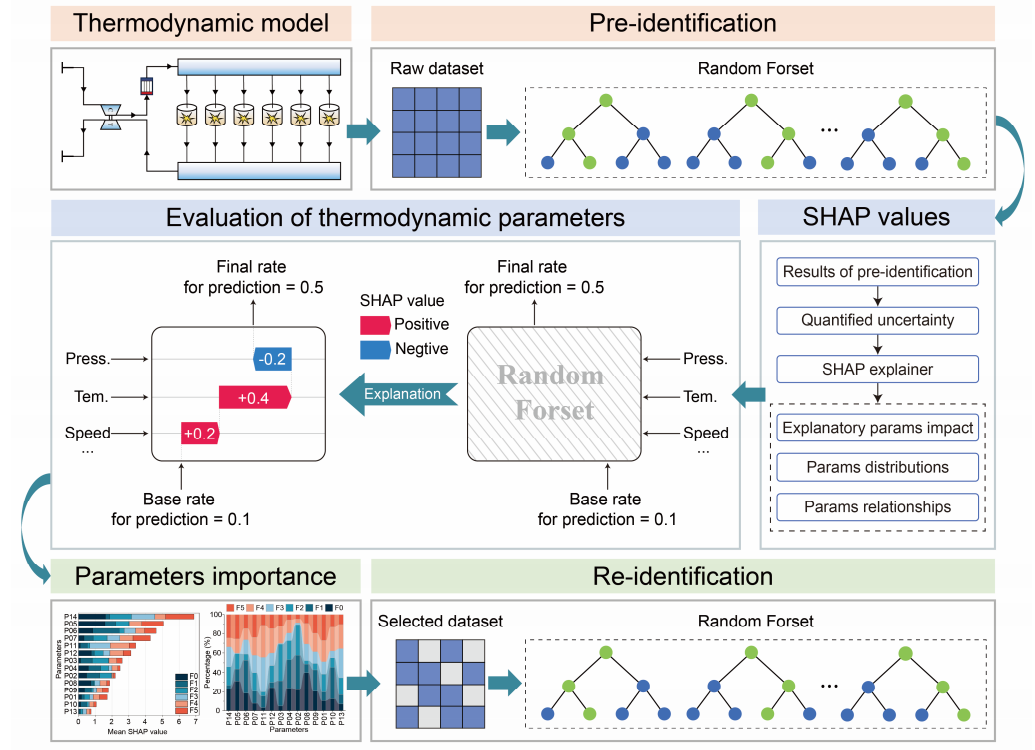
SHAP-based parameter selection process
Experimental Results & Performance Evaluation
Experimental validation demonstrates the effectiveness of the TSRF framework. Even in small-sample environments, the method achieves a diagnostic accuracy of over 95%, significantly outperforming traditional black-box models.
Moreover, the SHAP analysis successfully reveals the importance distribution of thermodynamic parameters across different fault types. This provides engineers with a reliable reference for Root Cause Analysis (RCA), turning a simple classification result into actionable physical insight.